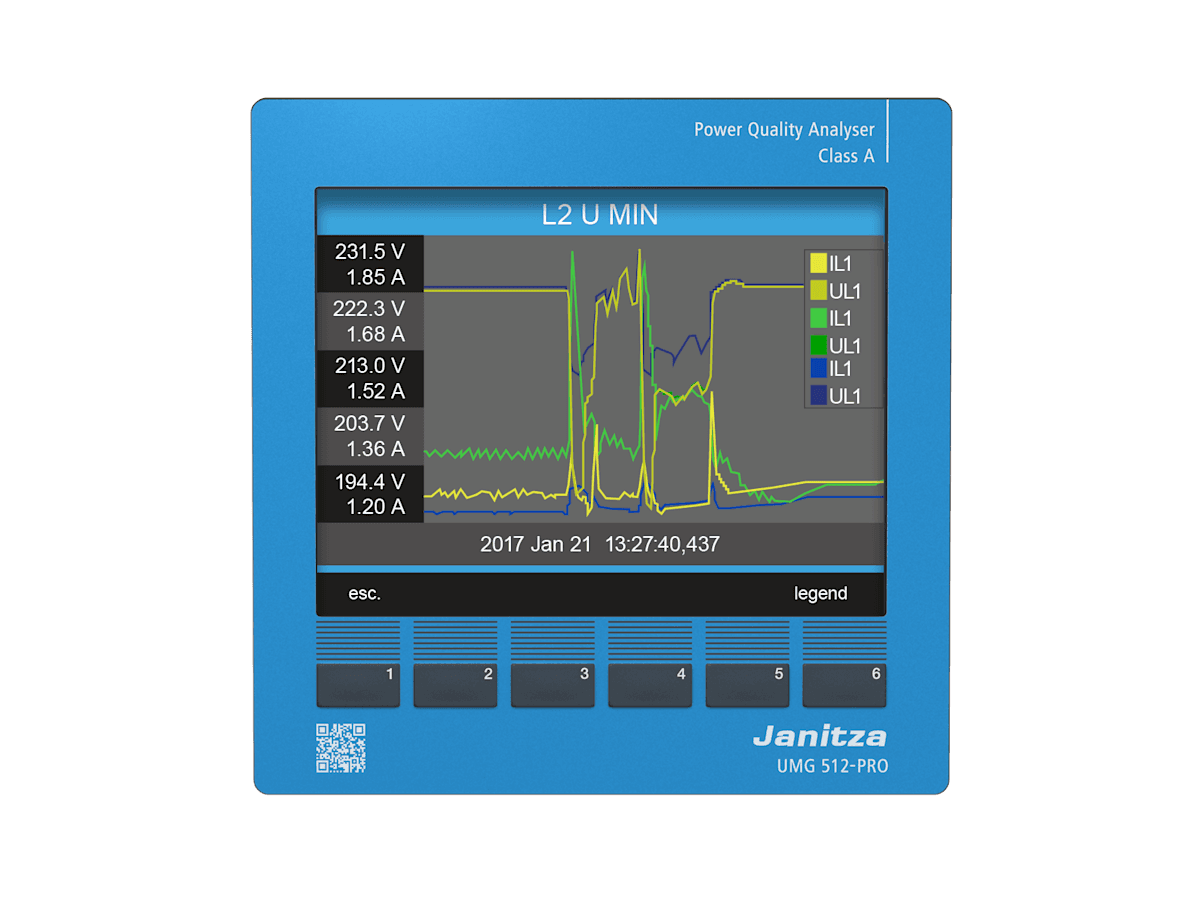
UMG 512-PRO
Certified power quality analyzer (Class A) + RCM
The UMG 512-PRO is a DIN-rail power-quality analyzer built to formally certify voltage quality against standards like EN 50160, IEEE 519, and EN 61000-2-4, while simultaneously performing continuous residual-current (earth-leakage) monitoring on the same device. It's positioned for facilities and utilities needing legally/contractually referenceable Class A power-quality compliance data alongside built-in "watchdog" apps.
Key Features
- 01IEC 61000-4-30 Class A certified measurement
- 02Built-in residual current monitoring (RCM), Type A per IEC/TR 60755
- 03Color graphic display 320×240, 256 colors, 6 buttons, multilingual (incl. Turkish)
- 04Built-in apps: Measured Value Monitor, EN 50160 Watchdog PRO, IEC 61000-2-4 Watchdog PRO
- 05BACnet IP (optional), Profibus DP/V0, Modbus RTU/TCP
- 06COMTRADE export; web-based device homepage
Applications
- Power Quality SolutionsPower quality problems such as harmonics, voltage sags and swells, flicker, transients and voltage unbalance can occur in electrical systems. They can arise from non-linear loads, sudden load changes, network events and the electrical structure of the facility itself. Poor power quality can cause overheating in equipment, nuisance tripping, energy losses, shorter equipment life and interruptions to production continuity. At EPKOM we use power quality analyzers to measure and monitor LV and MV systems, recording harmonics, voltage events and the other power quality parameters. We evaluate the resulting data against the relevant standards, such as EN 50160, IEC 61000 and IEEE 519, according to the measurement point and the scope of the application. Following measurement and analysis, we apply active and passive harmonic filters, SVG systems, compensation solutions and power quality monitoring systems according to the needs of the facility, helping the electrical infrastructure run more safely, efficiently and stably.
- Energy Monitoring SystemsEnergy monitoring systems measure and analyse electricity consumption continuously, at facility, feeder, department or machine level. Alongside electricity, other energy sources such as water, natural gas and compressed air can be tracked through the same system. Data from Janitza energy analyzers is collected centrally in the GridVis software, where consumption trends, load profiles and energy performance indicators can be followed. Automatic reporting and alarm functions make abnormal consumption and energy losses quick to identify. Energy monitoring systems help to allocate energy costs correctly, to identify inefficient points of consumption and to improve energy performance continuously. They also support ISO 50001 energy management processes and make it possible to track energy performance indicators such as PUE in data centers.
- Harmonic Filter SolutionsNonlinear loads such as frequency converters, rectifiers, UPS systems, power electronics equipment and arc furnaces can cause current and voltage harmonics on the network. High harmonic levels lead to overheating in transformers, cables and capacitors, to increased energy losses, to a risk of resonance and to unexpected failures in sensitive equipment. Harmonics are reduced with active or passive harmonic filter solutions selected according to the facility's load structure and harmonic spectrum. Passive harmonic filters are effective at reducing specific harmonic components, while active harmonic filters compensate harmonics in real time under variable load conditions, providing dynamic filtering. At EPKOM we determine the filter type and capacity that suits the facility from power quality measurements and harmonic analysis, and engineer our solutions taking IEEE 519 and the relevant IEC/EN standards into account. This reduces harmonic levels, protects equipment and allows the electrical system to run more safely and efficiently.
Technical Specifications
UMG 512-PRO
| Measurement inputs | 4 voltage inputs, 6 current inputs, 2 residual-current inputs |
|---|---|
| Voltage inputs | 3-phase 4-wire up to 417/720V; L-N 10–600 Vrms; L-L 18–1000 Vrms |
| Current inputs | Rated 5A; 0.005–7 Arms; 0.1 mA resolution |
| Residual current inputs | 0–40 mArms, 1 µA resolution; rated 30 mArms, 100 µA trigger, Type A |
| Accuracy | IEC 61000-4-30 Class A; active energy Class 0.2S; power/energy Class 0.2 at 50/60Hz |
| Harmonics | 1st–63rd (V & I), analysis up to 3 kHz |
| Communication protocols | RS485 (Modbus RTU); Ethernet (Modbus TCP, FTP, NTP); Profibus DP/V0; BACnet IP (optional) |
| Memory / data logging | 256 MB; up to ~2 years retention |
| Installation type | Fixed panel, upright; ~144×144×75 mm, cut-out 138×138 mm, ~1,080 g |
| Certifications / standards | IEC 61000-4-30 Class A, IEC 61557-12, IEC 62053-22, ANSI C12.20, EN 50160, ISO 50001, UL/IEC |
Technical values are taken from the manufacturer's published documentation. Confirm against the current datasheet before ordering.
Downloads
Datasheets, manuals and technical documentation are available from the manufacturer's document centre, or on request from us.
Get in Touch
Contact us about this product
Let us work out the right model for your application. Share your single-line diagram or measurement data and our technical team will review it.